

How to Play Texas Hold 'Em:
Welcome to the lesson that separates casual players from serious ones: understanding betting patterns, table rules, and the language of poker.
Every bet tells a story. When you check, you're saying something. When you raise, you're saying something different. When your opponent goes all-in, they're sending a message—and you need to know how to read it.
THE VIDEO will give you a solid foundation in betting, how to size your bets and how to track the meaning of other people’s betting. Below, find some advanced betting techniques that didn’t make it into the video. Use them carefully. Test them out when you’re feeling strong at the table.
Advanced Betting Tactics
Some advanced moves can elevate your game. Others just make you look fancy and may impress and intimidate less experienced players who will be forced, then to ask questions at the table about how things work.
The Straddle: This is an optional blind bet made by the player to the left of the big blind (or sometimes the button in button straddle games).
Before cards are dealt, the straddler posts double the big blind. This makes them the last to act pre-flop, and it increases the stakes for that hand.
Example: Blinds are $5/$10. The straddle is $20. Now everyone must call $20 to enter the pot, and the straddler can raise when action comes back to them.
Why do it? It creates action and bigger pots. If you're a strong post-flop player, you want bigger pots. It's also fun and loose.
The downside: You're posting $20 without seeing your cards. Mathematically, it's -EV (negative expected value) over time unless you're much better than your opponents.
The Blind Check (or Mississippi Straddle/Sleeper Straddle): This is a rarely-used tactic where the big blind announces before the flop that they'll check no matter what when action comes to them.
Why? It guarantees you'll see the flop for free if no one raises. It's a psychological move that encourages limping (calling the big blind) rather than raising.
This is uncommon in modern poker and not allowed in many casinos, but you might encounter it in home games.
Check-Raise for Value: You check with a strong hand, hoping someone bets so you can raise them and build a bigger pot.
Example: You have a set (three of a kind). You check, an opponent bets, and you raise. They're committed now and might call with a weaker hand.
Check-Raise as a Bluff: You check with nothing, an opponent bets, and you raise to make them think you have a monster.
This is high-risk, high-reward. If they call or re-raise, you're in trouble. But if they fold, you just stole a pot you had no right to win.
The Donk Bet: This is when you bet INTO the pre-flop raiser on the flop (rather than checking to them). It's called a "donk bet" because it's often considered a weak play.
Why it's often bad: You're taking control away from the pre-flop raiser, who usually bets the flop. You're also betting out of position, which is disadvantageous.
When it works: If you flopped a monster and want to disguise it, or if you're trying to take down the pot immediately against a pre-flop raiser who might check behind.
The Blocker Bet: A small bet made with a marginal hand to prevent your opponent from making a larger bet.
Example: You have a medium-strength hand on the river. You bet small (1/3 pot), hoping your opponent will just call or fold. If you check, they might bet large and you'd have to fold.
This is a defensive, controlling bet. It's advanced and situational.
The lesson: Every bet and check tells a story. You're a detective piecing together the narrative. When the story doesn't make sense (like betting then checking twice), it usually means weakness.
Poker is a game of information, psychology, and strategy. Master the rules, understand what your bets communicate, read your opponents' patterns, and you'll have a massive edge over players who just look at their cards and hope for the best.
Now get out there, bet with purpose, and always remember: in poker, a bet is never just a bet—it's a conversation. Learn to speak the language fluently, and you'll win far more than your fair share of pots.
TAKE THE EASY QUIZ BELOW TO MOVE ON TO THE NEXT LESSON!
LESSON FOUR - Betting Patterns, Table Rules, Strategic Signals
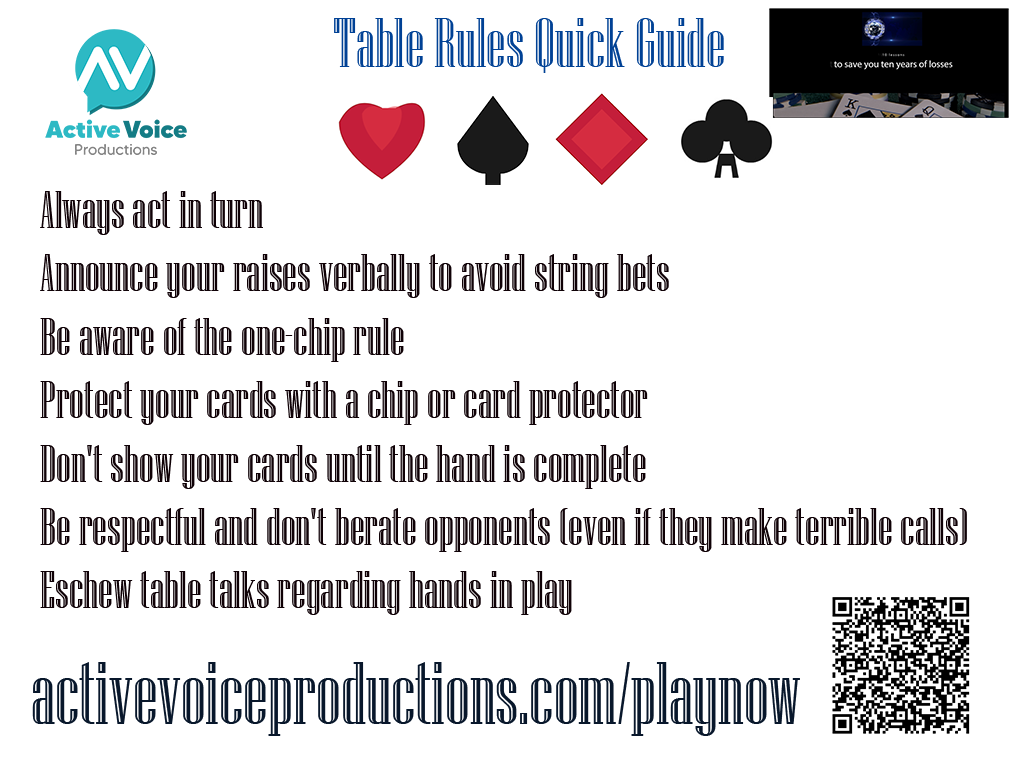
Click to download the Quick Guide PDF! Put it up on the bulletin board or print it tiny as a laminated wallet card reminder.

Lesson 4 Quiz
one-chip rule is?