
How to Play Texas Hold 'Em:
LESSON Five - Counting Outs / Calculating Odds
Introduction
Counting outs and calculating odds transforms poker from guessing and hoping into actual strategic decision-making based on probability.
Serious poker players have a distinct advantage over home-gamers or Vegas visitors. We understand the math.
Today, you'll learn what 'outs' are, how to count them accurately, simple mathematical tricks to calculate your chances of winning, and most importantly, how to use this information to make profitable decisions.
By the end of this lesson, you'll be able to quickly calculate — or at least estimate — whether a call is mathematically correct.
What Are Outs?
An 'out' is any card in the deck that will improve your hand to (likely) the winning hand.
Simple example: You have A♠ K♠, and the flop is Q♠ J♠ 3♦. You need one more spade for a flush. How many spades are left in the deck?
There are 13 spades total in the deck. You can see 2 (in your hand) and 2 more (on the board), so 13 - 4 = 9 spades remaining. Those 9 spades are your outs—any one of them gives you a flush.
Another example: You have J♥ 10♥, and the flop is Q♣ 9♦ 4♠. Any king or any eight gives you a straight. How many outs?
There are four kings in the deck and four eights in the deck. 4 + 4 = 8 outs.
The key concept: Outs are cards that turn your losing or marginal hand into a winner. The more outs you have, the more likely you are to improve.
Important caveat: An out only counts if it actually makes you the winner. This is called having a "clean out" versus a "dirty out." We'll come back to this.
How many cards are unknown? You see your 2 hole cards. After the flop, you see 3 board cards. That's 5 cards visible to you.
A deck has 52 cards, so 52 - 5 = 47 unseen cards after the flop. After the turn, you've seen 6 cards, so 52 - 6 = 46 unseen cards.
These are the cards that could come on the turn and river. Your outs are somewhere in those unseen cards."
Common Drawing Hands and Their Outs
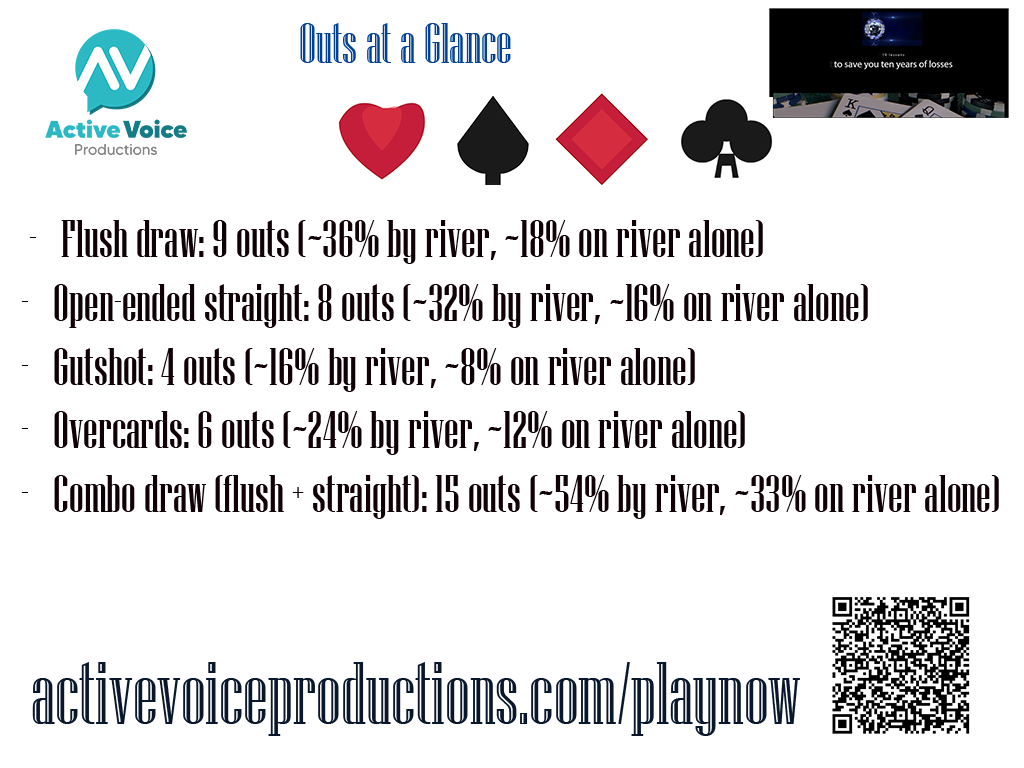
A reference chart for the most common drawing situations: Memorize these—they'll save you mental energy at the table.
Flush Draw (9 outs): You have two cards of one suit, and two more of that suit are on the board. Any of the remaining 9 cards of that suit complete your flush.
Example: You have A♦ 7♦, board is K♦ 9♦ 4♣.
Open-Ended Straight Draw (8 outs): You need one card on either end to complete a straight.
Example: You have J-10, board is Q-9-3. Any king or any eight (8 cards total) makes your straight.
Gutshot Straight Draw (4 outs): You need one specific card in the middle to complete your straight.Example: You have J-10, board is K-9-4. Only a queen makes your straight, and there are 4 queens in the deck.
Two Overcards (6 outs): You have two cards higher than any card on the board, and you think pairing either one will win.
Example: You have A-K, board is 10-7-4. Any ace or any king gives you top pair (6 outs total).
One Pair to Two Pair or Trips (5 outs): You have one pair and want to improve to two pair or three of a kind.
Example: You have K-Q, board is K-8-3. Any queen gives you two pair (3 outs), and any remaining king gives you trips (2 outs). Total: 5 outs.
Combo Draws: Sometimes you have multiple draws at once, and these are extremely powerful.
Example: You have Q♠ J♠, board is 10♠ 9♥ 4♠. You have an open-ended straight draw (any king or eight = 8 outs) AND a flush draw (any spade = 9 outs). But wait—the K♠ and 8♠ are counted in both, so we don't double-count them.
8 straight outs + 9 flush outs - 2 overlap = 15 outs. This is a monster draw—you're actually favored against most made hands!
The Rule of 4 and 2: Quick Odds Calculation
The magic trick that every poker player needs to know: the Rule of 4 and 2. This lets you quickly estimate your probability of hitting your hand.
The Rule of 4 (after the flop, with two cards to come): Multiply your number of outs by 4 to get your approximate percentage chance of hitting by the river.
Example: You have a flush draw (9 outs). 9 × 4 = 36%. You have roughly a 36% chance of making your flush by the river.
The Rule of 2 (after the turn, with one card to come): Multiply your number of outs by 2 to get your approximate percentage chance of hitting on the river.
Example: You have a flush draw (9 outs) and missed on the turn. 9 × 2 = 18%. You have roughly an 18% chance of making your flush on the river.
Why does this work? After the flop, there are 47 unseen cards and two chances to hit (turn and river). Each out is roughly worth 2% per card. Over two cards, that's about 4% per out (it's not exact, but close enough).
After the turn, there are 46 unseen cards and one chance to hit. Each out is worth about 2.17%, so 2% is a good approximation.
Practice this: Get in the habit of counting your outs and multiplying by 4 or 2. It takes two seconds and gives you crucial information.
IF you have a flush draw (9 outs) on the turn. Using the Rule of 2, you have 9 × 2 = 18% chance to hit on the river.
The pot is $80, and your opponent bets $20. The pot is now $100, and you must call $20.
Your pot odds: $100 to $20 = 5-to-1, or 16.7% (you need to win 1 in 6 times to break even).
You have 18% equity and you only need 16.7% to break even, so this is actually a profitable call even without considering implied odds!
Wait—implied odds!?!?
Implied odds consider the money you might win on future betting rounds if you hit your hand.
In the above example, if you make your flush on the river, your opponent might pay you off with another bet. Let's say you expect to win an additional $40 on the river if you hit.
Now your implied pot is $100 (current) + $40 (future) = $140. You're calling $20 to win $140, which is 7-to-1 odds, or 12.5% equity needed. Your 18% equity makes this a clear call!
Example 3 - The River Decision: It's the river. The pot is $200. Your opponent bets $100.
You have A-high. You think you're beat, but there's a small chance your opponent is bluffing.
Pot odds are at 33.3%. You need to win at least 1 third of the time for this call to be profitable.
Here's the key question: Is your opponent bluffing more than 33% of the time in this spot?
If yes → Call (it's +EV).
If no → Fold (it's -EV).
River Decision-Making
Now let's talk about river decisions. On the river, all the cards are out. No more improving. You either have a winning hand or you don't. Your decision is purely about pot odds and estimating your opponent's range.
IF You Have a Weak Hand
The pot is $200. Your opponent bets $50. You have bottom pair. You consider calling.
Pot odds: $300 to $50 = 6-to-1, or 16.7%. You only need to be good 1 in 6 times to call profitably.
Think: Does this opponent ever bet $50 with worse than bottom pair? If they're bluffing or betting worse 20% of the time, call. If they only bet this way with strong hands, fold.
IF You Have a Strong Hand
You have A♠ Q♠ on a board of A♣ K♦ 9♥ 5♣ 2♠. You have top pair, decent kicker. The pot is $100. Your opponent bets $150.
Pot odds: $250 to $150 = 1.67-to-1, or 37.5%.
Your hand beats: Any missed flush draw, any weaker ace (A-J, A-10, etc.), bluffs. Your hand loses to: Two pair, sets, better aces (A-K).
Do you win more than 37.5% of the time here? That depends on your opponent. If they're aggressive and can be bluffing, call. If they're tight, fold.
IF you Face an Overbet
The pot is $100. Your opponent bets $200 (twice the pot!).
Pot odds: $300 to $200 = 1.5-to-1, or 40%.
An overbet often polarizes their range into "nuts or air." They either have a monster and want maximum value, or they're bluffing big to push you out.
If you think it's 60% bluff / 40% monster, call. If you think it's 80% monster / 20% bluff, fold. This is where player reads matter.
IF You Have a Marginal Made Hand You have 9♥ 9♠. Board after river: K♣ 8♦ 5♠ 3♣ 2♠.
You have a pair of nines—medium strength. Your opponent bets $40 into a $60 pot.
Pot odds: $100 to $40 = 2.5-to-1, or 28.5%.
Your hand beats: Any missed draws, pocket pairs lower than 9s, total air. Your hand loses to: Any king, pocket tens or better, two pair, sets.
How often does this opponent have worse than nines? If it's more than 28.5% of the time, call. This is a "bluff-catcher" call—you're not strong, but you beat bluffs.
Factors that favor calling: The board is dry (no obvious draws missed). The opponent is aggressive. The bet size is small to medium.
Factors that favor folding: The opponent is tight and only bets with strong hands. The bet size is huge.
Final Tips
Key Mental Steps:
1. Count your outs
2. Multiply by 2 or 4 for your percentage
3. Calculate pot odds (pot / (pot + call))
4. Compare equity to pot odds
5. Consider implied odds if you're close
6. Make the mathematically correct decision
Final Wisdom: Poker rewards those who make +EV (positive expected value) decisions. You won't always win, but if you consistently make calls when your equity exceeds your pot odds, you'll profit long-term.
Don't fixate on single-hand results. Just because you called correctly and lost doesn't mean it was wrong. If you had 60% equity and lost, you made the right call—variance just went against you this time.

Lesson 5 Quiz
You hold:
The flop comes:
You have an open-ended straight draw (any 6 or Jack completes your straight).